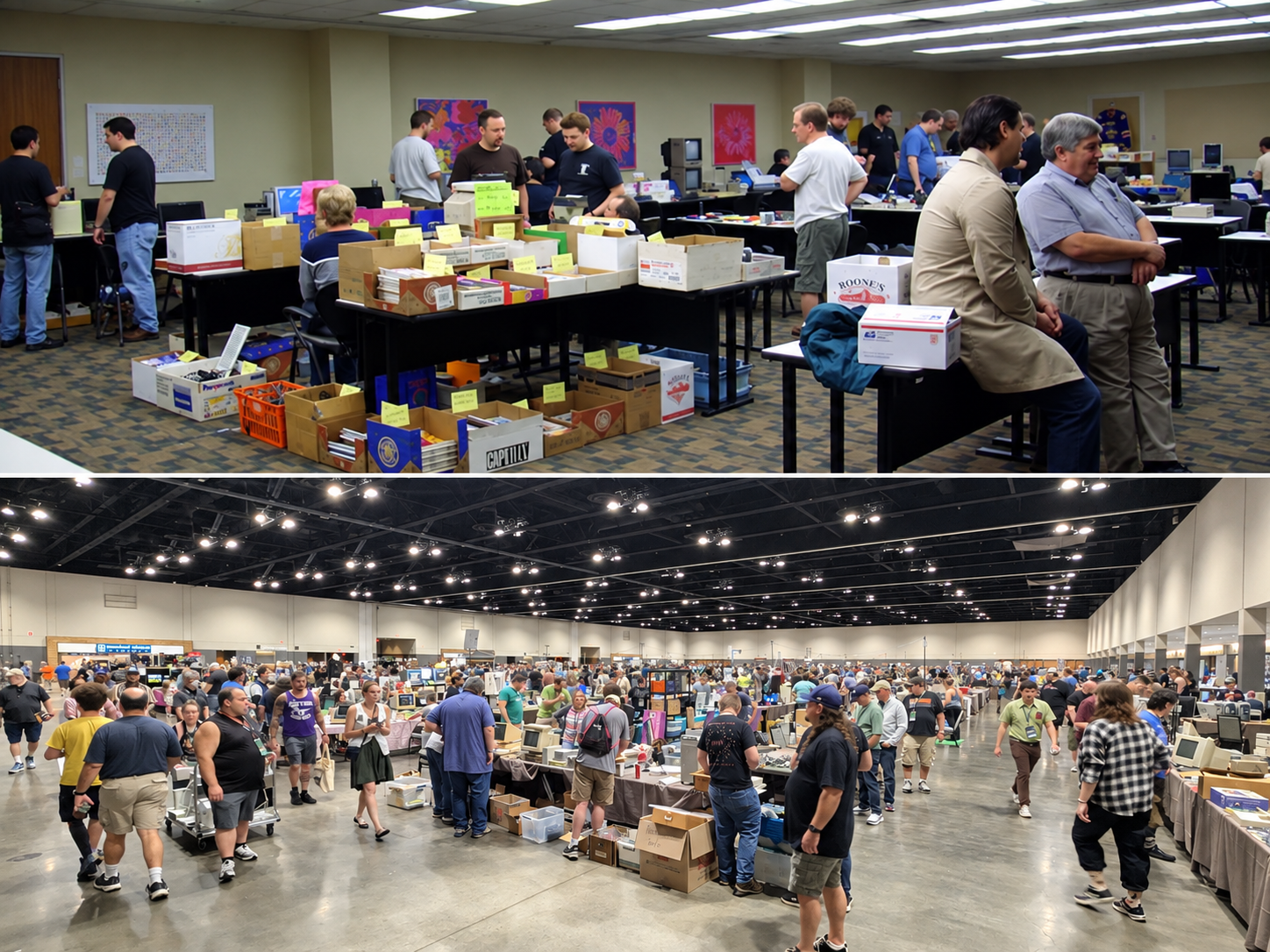
The photo above shows the same event, sixteen years apart.
At the top is Vintage Computer Festival Midwest 5.0 in 2010. At the bottom is VCF Midwest 21 in 2026.
The contrast is remarkable.
VCF Midwest started in a couple of rooms on a college campus. The earliest shows were held at Purdue University in West Lafayette, Indiana. By VCF Midwest 5.0, the show had already outgrown Purdue and moved to a slightly larger facility at the Heron Point Building in Lombard, Illinois.
Folding tables were covered with vintage computers, software, documentation, spare parts, and cardboard boxes of assorted treasures. Exhibitors and visitors wandered between the tables, talked about old hardware, traded equipment, and showed off the machines they had managed to keep running.
It had the atmosphere of a computer club meeting, swap meet, and vintage computer exhibition all rolled into one.
And then it grew.
Sixteen Years Later
Fast-forward to VCF Midwest 21 in 2026.
What once fit into a modest room in Lombard has grown into an event occupying approximately 100,000 square feet of exhibition space
The lower half of the photo gives some sense of the scale, but even a wide-angle photograph has trouble capturing it. Rows of exhibits stretch across the hall, with vintage computers, restoration projects, vendors, organizations, demonstrations, and thousands of visitors filling the space.
Put the two photographs together and the growth becomes much easier to appreciate.
The 2010 photograph isn’t some unrelated little computer swap meet. That’s VCF Midwest.
And so is the enormous hall underneath it.
The Computers Got Older. The Show Got Bigger.
There’s another interesting consequence of those sixteen years.
Some of the computers sitting on tables at VCF Midwest 5.0 weren’t particularly ancient in 2010. Sixteen more years have passed since then. Machines that were simply obsolete or unwanted are increasingly becoming artifacts worth documenting and preserving.
At the same time, interest in vintage computing has expanded well beyond the relatively small community that kept these machines alive during the early years.
Today you’ll find everything from early microcomputers and terminals to workstations, minicomputers, game systems, unusual peripherals, restoration projects, homebrew hardware, and modern recreations of long-obsolete technology.
Yet despite the enormous change in scale, the reason people come hasn’t changed much.
Someone brings an interesting old computer. Someone else recognizes it. A conversation starts. Stories get exchanged. Somebody learns how the machine worked. Maybe a piece of hardware or documentation finds a new home instead of ending up in a dumpster.
That’s how a surprising amount of computing history gets preserved.
Same Idea. Slightly Bigger Room.
These two photographs capture a little piece of that history particularly well.
VCF Midwest 5.0 — 2010.
VCF Midwest 21 — 2026.
Sixteen years apart.
VCF Midwest 5.0 marked the festival’s move away from its early university-campus roots and into a slightly larger venue of its own.
Sixteen years later, it fills approximately 100,000 square feet with vintage computers, exhibitors, vendors, presentations, and thousands of people who share a passion for keeping computing history alive.
From a modest room in Lombard to 100,000 square feet of vintage computing.
That’s quite an upgrade.
Find out more about VCFMW on their website!
Photo credits: Hannah Novak, Garrett Meiers.